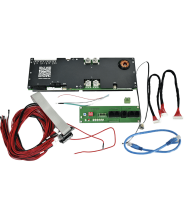















Balancers for LiFePO4: when you need to reverse and reverse the battery
What balancers are needed when purchasing a ready-made battery?
If you buy a ready-made LiFePO4 battery, the power supply of the balancers (devices that balance the voltage between adjacent batteries during charging) is not guaranteed. Virobniks themselves turn, if they themselves are necessary balancers.
Another way is a self-folding battery. Here balancers become relevant, especially if the total storage capacity exceeds 40 A year. For smaller batteries (up to 40 A year), the required balancing is successfully installed using the BMS (Battery Management System) board.
What kind of balancers are suitable for LiFePO4?
For lithium phosphate batteries, it is recommended to use passive balancers instead. The principle of their operation is simple: they identify the circuits that have reached the optimal voltage (namely 3.6 V), and force them to charge, and the excess energy dissipates in the form of heat. Passive balancers work wonderfully with the BMS, do not harm the battery life and work correctly.
Why are active balancers not suitable?
Active virulents work differently - they redistribute energy between the chambers, taking from those already charged and transferring them to those that are still charging. For LiFePO4, such devices are not recommended, as residual parts can reduce the battery life and interact incorrectly with the BMS board.
How can you convert LiFePO4?
Theoretically, yes. LiFePO4 does not contain rare acid, like lead-acid batteries, so this is of no consequence. The electrolyte reliably seals the middle of the chambers. Well, operation is possible practically in any situation.
Ale є nuances!
We strongly recommend that you read the instructions for your battery right away. Virologists often defend inversion for a variety of reasons:
- specificity of heat transfer (heat exchange may be disrupted by non-standard heating);
- features of the layout of the compartments and other internal elements;
- It’s trite to play it safe.
In addition, important batteries may be accidentally released during inversion testing or other mechanical damage may occur. It’s better to follow the rules recommended by the doctor.